Published April 14, 2026 · 9 min read · By Nirav Modi, Solution Architect
Prototype to MVP: The Rapid Conversion Playbook Founders Wish They Had Sooner
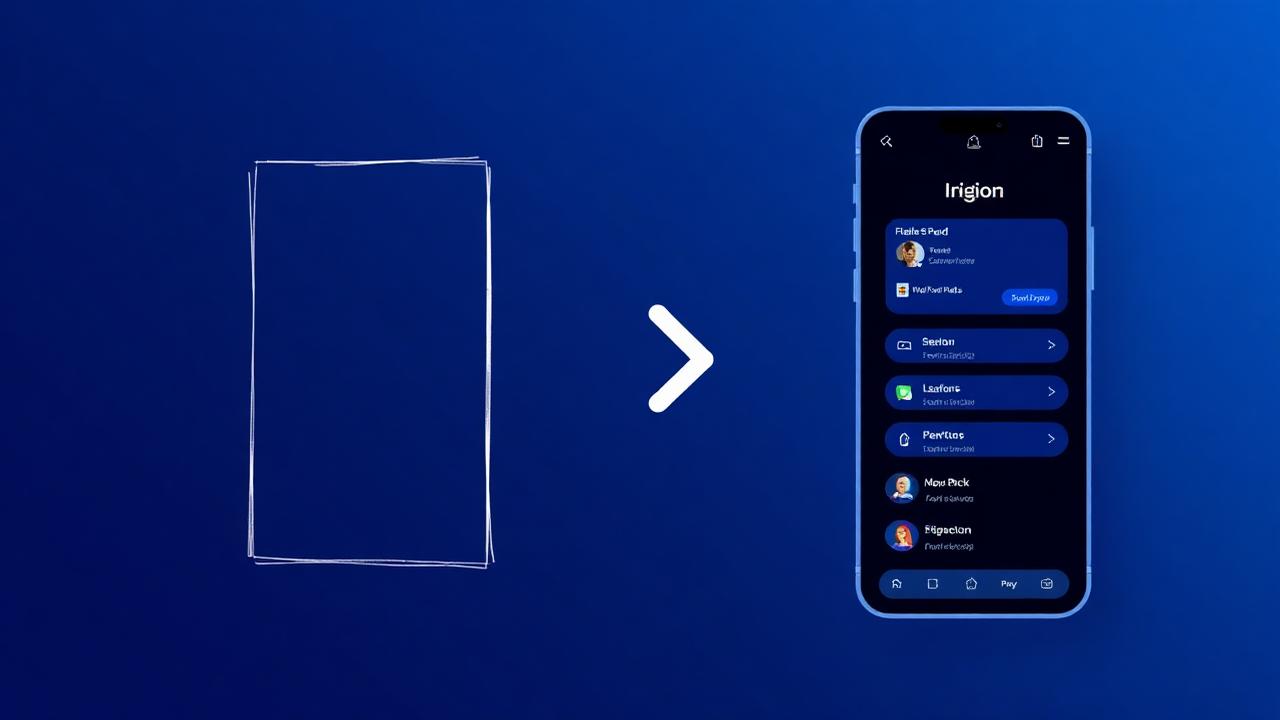
Quick Answer
Converting a prototype to MVP takes 3–6 weeks and costs $10K–$40K. The key steps: audit and cut 40% of the prototype's scope, map screens to a real data model, make one core user journey production-perfect, then add auth and hosting. The prototype is your map — the MVP is the road you actually build.
We get the same email about twice a month. A founder has a beautiful Figma prototype, maybe a clickable Lovable build or a v0 mockup. Investors loved it. Customers asked when they can use it. And then nothing happened for three months because the team underestimated what it actually takes to turn "looks like a product" into "is a product." This piece is the conversion playbook we wrote after watching that movie 40+ times.
The honest difference between a prototype and an MVP
A prototype answers one question: "Would users want to use this?". An MVP answers a harder one: "Will users keep using this when nobody is holding their hand?". The gap between those two questions is roughly six layers of unsexy work:
- Real user accounts (not hardcoded "demo@user.com").
- Persistent data with proper schema design.
- Permissions that hold up against a curious user with browser DevTools.
- Error states for every network call (because the network will fail).
- An onboarding flow that works without a Loom from the founder.
- A way to deploy a fix at 9pm without breaking everything.
None of those exist in a prototype. All of them have to exist in an MVP. That is the entire game.
Step 1: Audit the prototype, kill 40% of it
Open the prototype with the founder and physically cross out every screen that does not directly support the single most important user action. The first time we do this with a founder it is uncomfortable. By the end they are usually relieved — that "Settings" tab they spent two days designing was not going to ship anyway.
Step 2: Map every screen to a real data model
Prototypes lie about data. Lists are usually 3 hardcoded items. Forms accept anything. Edit actions don't actually edit. Before any code starts we draw the database schema on paper: entities, relationships, what gets indexed, who can read each row. Roughly 80% of post-launch rewrites we are called in to do trace back to a schema that was invented mid-build instead of designed up front.
Step 3: Pick the one journey to make production-perfect
Founders try to make every flow equally polished. That is how you ship in November instead of September. Pick one journey — usually onboarding through to first "aha" moment — and make that one feel like a $1M product. Everything else can be 60% finished. Users will forgive a slightly ugly settings page; they will not forgive a broken sign-up.
Step 4: Add the boring foundation early, not later
The temptation is to wire up auth and analytics "after the demo works." That is exactly backwards. We add these in the first 48 hours of the build:
- Real authentication with email verification and a recovery flow.
- Row-Level Security on every table that touches a user.
- An error tracker (Sentry / Highlight) catching every uncaught exception.
- Product analytics with three or four real events, not 47 vanity ones.
- A staging environment that mirrors production exactly.
These take roughly two days up front and save roughly two weeks during stabilisation. Every single time.
Step 5: Soft launch to ten people you know personally
Not Product Hunt. Not your LinkedIn. Ten people who already trust you, who will tell you when something is broken, and who will use the product more than once. The point is to find the bugs that only show up when humans (not your QA scripts) interact with the product. Budget three to five days for this round.
Step 6: Public launch with one CTA, one promise, one metric
The cleanest launches we have shipped have a single landing page, a single call to action, and the founder watching one number for the first 14 days (signup-to-activation rate, almost always). Everything you measure in week one becomes the input for what to build in week three.
Realistic timeline for prototype-to-MVP conversion
- Simple SaaS prototype, single user role: 10-14 working days, $7K-$14K.
- Two-sided marketplace prototype: 3-5 weeks, $18K-$35K.
- AI-powered prototype with a real model loop: 2-4 weeks, $12K-$28K depending on integrations.
- Anything regulated (health, finance, identity): 8 weeks minimum. Do not let anyone tell you otherwise.
The mindset shift that makes the whole thing easier
Stop thinking of the MVP as "the prototype but real." Think of it as a different productthat happens to look the same. Once that lands, the whole conversation about scope, polish, and timeline gets dramatically easier. The prototype proved demand. The MVP proves usage. You have two different problems to solve, and they deserve two different conversations.